On Arcads, credits on the Starter ($110) and Creator ($220) plans reset at the end of each billing cycle, and generation stops when you hit the limit. Only Pro ($550) and above roll unused credits over. That one rule decides whether Arcads costs you $11 a video or quite a bit more.
The rules below are from Arcads' help center and in-app pricing catalog, read on 12 November 2026. Arcads' public pricing page returned a 404 that day, and Arcads says it "tests new pricing from time to time, so your account may use different rates."
Turning credits into videos
| Plan | Price | Credits | Talking videos (800 each) | Left over | $ per video if all used |
|---|---|---|---|---|---|
| Starter | $110 | 8,000 | 10 | 0 | $11.00 |
| Creator | $220 | 16,000 | 20 | 0 | $11.00 |
| Pro | $550 | 48,000 | 60 | 0 | $9.17 |
| Scale | $1,100 | 96,000 | 120 | 0 | $9.17 |
| Business | $2,200 | 192,000 | 240 | 0 | $9.17 |
The credit allowances divide neatly by 800, which is the cost of one Arcads 1.0 talking-actor video (up to 2 minutes). If you make only talking videos, the plans are effectively 10, 20, 60, 120 and 240 videos a month.
Real usage isn't that tidy. You'll also spend on images (free up to 100 per 24 hours, then 8 to 32 credits), Seedance or Veo clips, captions, translation and retries. Every 800 credits spent on something else is one less talking video.
Why the reset matters
When credits reset, what you pay per video depends on how many you actually make. The plan's allowance only sets the best case.
| Videos made on Starter | Credits used | Credits lost at reset | Effective $ per video |
|---|---|---|---|
| 10 | 8,000 | 0 | $11.00 |
| 8 | 6,400 | 1,600 ($22) | $13.75 |
| 6 | 4,800 | 3,200 ($44) | $18.33 |
| 4 | 3,200 | 4,800 ($66) | $27.50 |
A team that makes six videos in a slow month on Starter is paying $18.33 each instead of $11, and a few slow months add up over a year.
The same applies to Creator. Make 12 videos instead of 20 and your effective price is $18.33.
And the hard stop at the limit
The other half of the Starter and Creator rule: when credits run out, generation stops. You can't buy a little more on the same plan. Your options are to wait for the cycle or upgrade.
That creates an awkward jump. Twenty-one videos in a month don't fit Creator. The next plan is Pro at $550, and Pro is the first tier that bills overage instead of blocking. So the effective step is from $220 to $550 for one extra video. Pro's unused credits then roll over, which helps in later months, but the first bill stings.
Why vendors structure credits this way
Use-it-or-lose-it credits are common in subscription software. They encourage steady usage and smooth out revenue. Putting rollover and overage on the top tiers also nudges heavier users up the ladder. It's a normal business choice, and you should still price it in.
Arcads isn't alone: MakeUGC, invideo and Higgsfield don't roll credits over either, and Creatify keeps them one extra month.
How to keep the reset from costing you
- Size for your slow month. If you make 6 to 12 videos, Starter with an occasional upgrade beats Creator that half-empties.
- Batch near the end of the cycle. If credits are left in the last week, spend them on concept tests you'd otherwise skip.
- Plan cut-downs before you render. Each talking video is a fresh 800-credit charge, so decide which 15-second and 30-second versions you need up front. Trim, stitch and resize are free on Arcads.
- Watch the agent. Mark agent chats are charged by token on top of generations. One reviewer said it "regenerated the rest of the ad without asking and burned ~3,000 credits", which is nearly four talking videos.
- Know your cancel date. Canceling means losing unused credits.
When the reset is harmless
If your volume is perfectly steady, ten videos a month, every month, Starter works out to a clean $11 each. Arcads also refunds failed generations automatically, which removes one common source of credit burn. Most ad teams don't produce that evenly, though: launches, tests and slow weeks all move the count.
The better option: credits that roll over
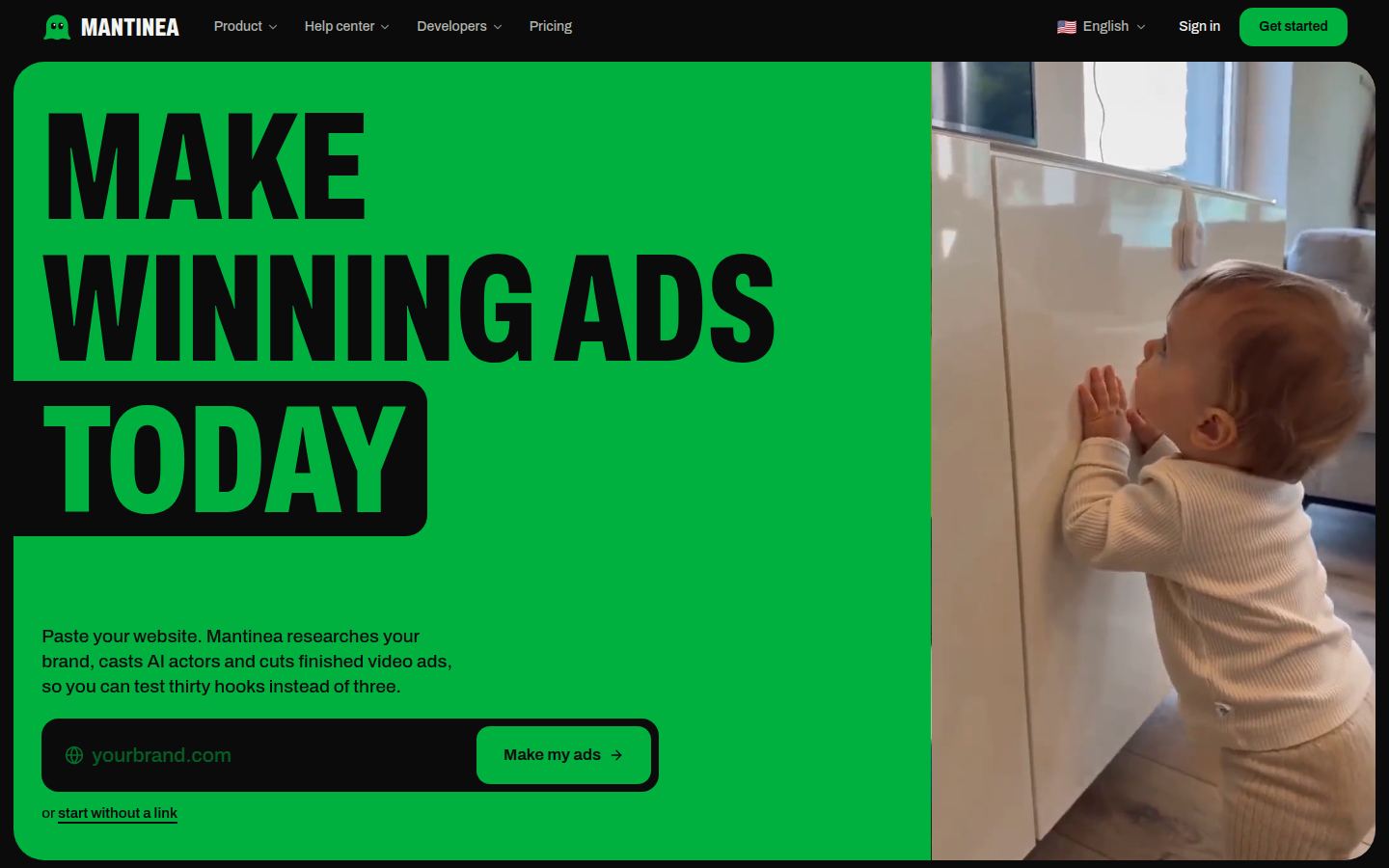
If your production is uneven, a tool that keeps unused credits removes the problem, and Mantinea is the one we'd pick. Here is why it wins on the exact issues above:
- Rollover on every plan. Unused credits roll over with no cap while you're subscribed, and stay usable for 30 days after a plan ends. Arcads keeps rollover for Pro at $550.
- No hard stop. Credit packs ($12 for 1,000 up to $450 for 50,000) stack on any plan, so the 21st video doesn't force a $330 jump.
- A lower entry price. Starter is $29 for 2,900 credits. A 30-second talking-actor ad is 450 credits, or $4.50, against $11.00 on Arcads Starter. Pro actors, licensed real-actor footage, cost the same 15 credits a second.
- Every feature on every plan. Seats are unlimited and the API and MCP are on Starter; on Arcads all three start on Pro.
- No-card trial. 14 days and 1,000 credits, against a 72-hour card trial that converts to $110.
- Chat that doesn't drain the balance. Agent replies are not charged in credits, and a spend rule decides when the agent must ask before a paid job.
- Cheaper retries. Hook lab renders only a new opening (a 3-second hook is $0.36), and Edit video re-renders only the section with a changed line, so a fix isn't a fresh full charge. Failed or canceled jobs are refunded automatically.
Our pick
1. Mantinea
Credits that roll over, on a plan with every feature from $29
Specifications
- Plans from
- $29/month (2,900 credits)
- Rollover
- Every month, no cap
- Talking actor
- 15 credits/s, about $4.50 per 30 s
- Seats
- Unlimited
- Languages
- 182, up to 10 at once
Reasons to buy
- +No hard stop: top-up packs on any plan
- +API, MCP and seats on the entry plan
- +Failed or canceled jobs refunded automatically
Reasons to avoid
- −No manual frame-by-frame timeline editor
- −A newer name than Arcads
Buy it if Your monthly volume goes up and down
Buy it if A team shares one budget
Don't buy it if You need human creators shipping your product
For the full Arcads plan breakdown, including the trial, see Arcads pricing (2026). For how credit systems mislead in general, see why "$ per 1,000 credits" can mislead you.