On invideo's Starter plan you pay per seat, which means an ad team of three pays three times over. Its terms also say unused credits don't roll over and that it may "update credit costs at any time, without prior notice." Anyone budgeting a quarter of creative tests should weigh those terms above the sticker price. Mantinea plans come with unlimited seats, carry credits forward and show what each job costs before it runs. Below we start with the bill and then explain why the tools suit different work.
The invideo details come from its own pages and Trustpilot, read on 12 November 2026; Mantinea's prices come from its 24 November 2026 price list. Prices move, so check them before you buy.
Billing terms compared
| Term | Mantinea | invideo |
|---|---|---|
| Plan lineup | Starter $29 (2,900 credits), Growth $79 (8,200), Pro $199 (21,000), Scale $499 (55,000); yearly billing takes 20% off | Starter $20 per seat (400 credits), Plus $60 (2,000), Max $150 (5,000), plus an annual promo |
| How seats are billed | Unlimited, every plan | Starter charges per seat |
| Leftover credits | Carry into the next month while you subscribe | "Unused credits don't roll over" |
| Changes to credit pricing | Each generate button shows the price before it runs | "We reserve the right to update credit costs at any time, without prior notice." |
| Jobs that fail | Refunded without asking | Not stated |
| Trying it free | 1,000 credits over a 14-day trial, no card | No free plan shown |
| Which plan has which features | All features on all plans | Context Engine needs Enterprise |
| Limits on spending | Caps by day, week and month | Not listed |
For a team of three on the entry plans, invideo Starter costs $60 a month (3 x $20) and Mantinea Starter costs $29. In a quiet month, invideo's unused credits are gone; Mantinea's move forward.
When we checked, invideo had a Trustpilot score of 1.8 across about 1,000 reviews, and credit consumption kept coming up. One reviewer said the agent's "conversations, memory operations, balance checks, and project planning were consuming credits the entire time". Mantinea doesn't charge credits for agent chat replies; you pay only for generations.
Cost a variant rather than a video
In a testing program you're buying variants. Suppose you have a 30-second ad that's winning and you plan the following week on Mantinea. Five fresh 3-second openings from Hook lab, billed at 12 credits per second of new hook with a 2-second minimum, cost 180 credits ($1.80). A lip-synced dub of the winner into German and Spanish, at 560 credits a minute for 30 seconds each, costs 560 credits ($5.60). The week totals 740 credits, or $7.40.
Because Hook lab only bills the new seconds at the start, you don't pay for the body a second time. Rendering five new 30-second ads at the standard talking-actor rate of 15 credits per second would have cost 2,250 credits. A few more unit prices: 1 credit to resize to another ratio, 2 for captions, 90 per minute per language for an audio-only dub. Credits saved in a light week are there for a heavy one.
What each product actually is
invideo bills itself as "Agent Two - The agentic video editor for serious creatives." AI agents work on a multitrack timeline, and the pitch covers social media, microdrama, advertising and filmmaking. You get an editing agent that logs each clip, batch edits that span shots, a co-writer for scripts, audio and color tools, custom agents (colorist, cinematographer, scriptwriter), multiplayer editing, avatars, an AI twin "in 50+ languages" and pages for UGC Ads.
Mantinea is designed for making performance ads and testing them. Hand it your website and Brand Brain reads as many as 40 pages; given a demo login, it signs into your app and records real product flows. It drafts scripts and hooks and casts the presenter, who can be a synthetic (fictional) library actor, your own actor made from a photo or a video you consented to, or a Pro actor, meaning licensed footage of real stock actors in their own settings across 1,100+ takes. It then renders the ad, multiplies it with Hook lab and a Variations matrix, and finishes it with Edit video, captions, resizing, dubbing and Brand finish (which adds captions, logo and end card in one step).
Testing features compared
| What you need | Mantinea | invideo (pages read 12 Nov 2026) |
|---|---|---|
| Spread one ad across hooks, actors, formats and languages | A Variations matrix that shows the credit total before running | Agent batch edits; we found no matrix |
| Retest just the opening of a winning ad | Hook lab | Not found |
| Look at competitors' ads | Ads library to pull, play, break down and remix | None found |
| Research your brand | Brand Brain and app exploration, on every plan | Context Engine, Enterprise only |
| Language coverage | 182, lip-synced, up to 10 at a time | 50+ |
| Reviewing work | Approvals and timecode comments | Guest seats, comments |
| Tracking results | Per-variant hook rate, CTR, CPA and ROAS, with CSV export | Not listed |
Good testing changes one variable at a time, which is why Hook lab and the matrix carry the most weight in that table. To design the grid itself, see the explainer on hooks x actors x formats matrices.
Mantinea also puts the real product into ads with presets like Fashion try-on, Unboxing POV, Product in hand and Show your app, and helps with research through creator discovery across real YouTube, X, Instagram and TikTok creators. Every plan includes workflows, scheduled routines, the public API and a hosted MCP server.
What happens after a test reads out
Think about your next move once results are in. Maybe you drop four cells, hold on to the winning body, try five fresh hooks on it and then dub whatever survives into German and Spanish. That's a testing workflow, and Mantinea is made for it; the concepts-then-hooks testing framework lays out the sequence. If your next move is to open a multitrack timeline and recut each frame yourself, you need a manual editor. Mantinea's Edit video can rewrite a line and re-render only the sections that changed, and Fix a moment repairs a brief glitch, but it has no frame-by-frame timeline.
Our pick
Our pick for paid social
1. Mantinea
One flat price for the team, rollover credits and a workflow costed per variant
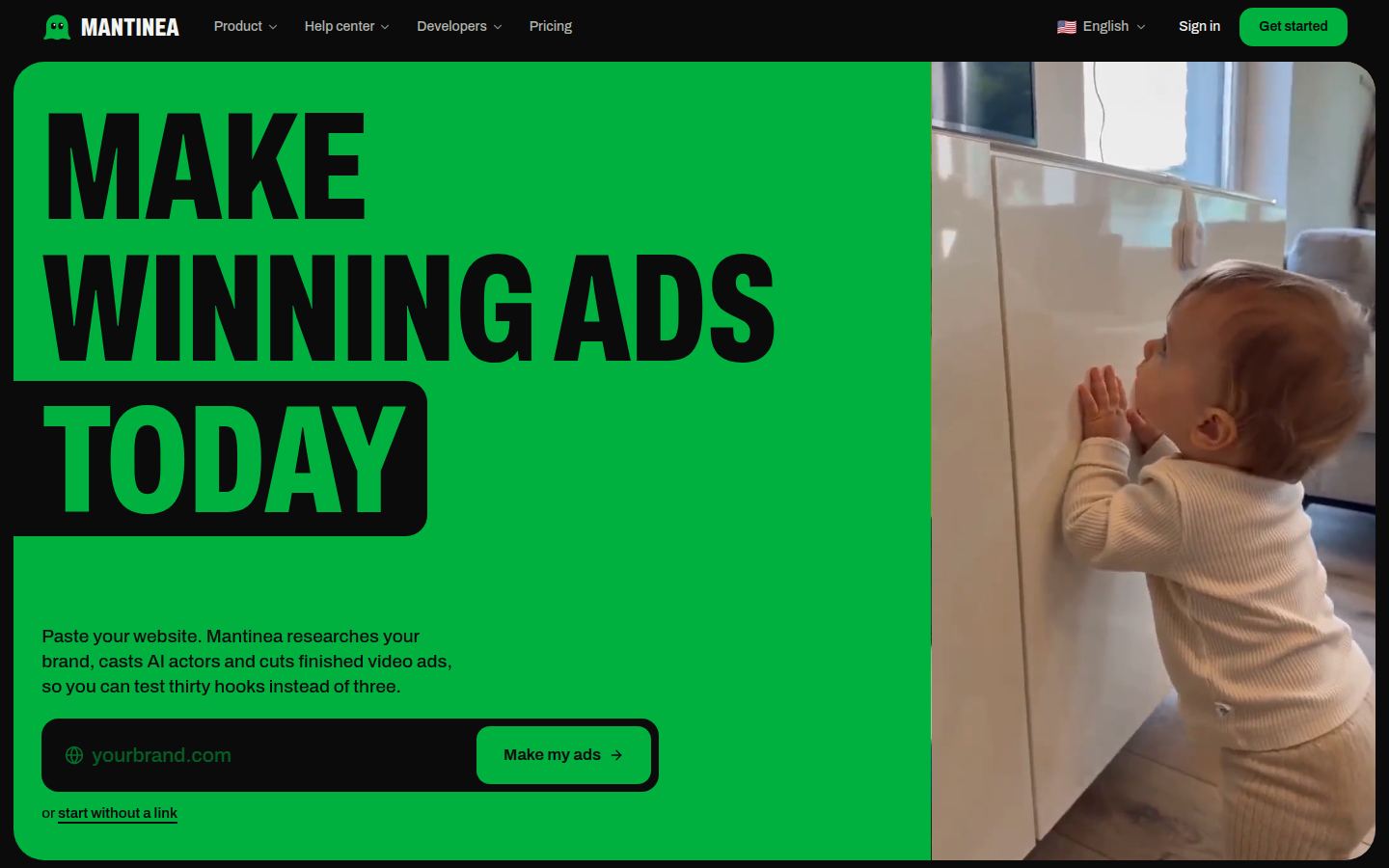
Specifications
- Entry plan
- $29/month with 2,900 credits
- Trial
- 14 days, no card needed
- Team
- Unlimited seats
- Credits
- Carry over; failed jobs refunded
- Localization
- 182 languages, 10 at once
Reasons to buy
- +You see each job's price before it starts
- +A team of three pays what one person pays
- +Retesting an opening bills only the new seconds
Reasons to avoid
- −Its name is newer than invideo's
- −There's no manual frame-by-frame timeline
Buy it if You want spending next quarter to be predictable
Buy it if Your team puts out tested ads every week
Don't buy it if Most of your work is narrative or long-form timeline editing
As an invideo alternative for paid social, Mantinea is the stronger choice. The team pays once rather than per seat, credits from a quiet month stay put, failed jobs are refunded automatically, and the whole workflow centers on the variant. The trial's 1,000 credits pay for two 30-second talking ads plus a couple of hook tests, which is enough to see how it handles your product.